
Lot Clearing for a House Site in Callahan, FL
Clearing a lot for a new home around Callahan, Hilliard, Bryceville or western Yulee is a sequence, and on flat, sandy flatwoods it starts with water: where the septic system can go, how high the water table rises, and how the driveway crosses the roadside ditch. Then come the paperwork, tortoise burrows and wetlands, the clearing and the stumps. Here's the order that works, the local rules, and what it costs.
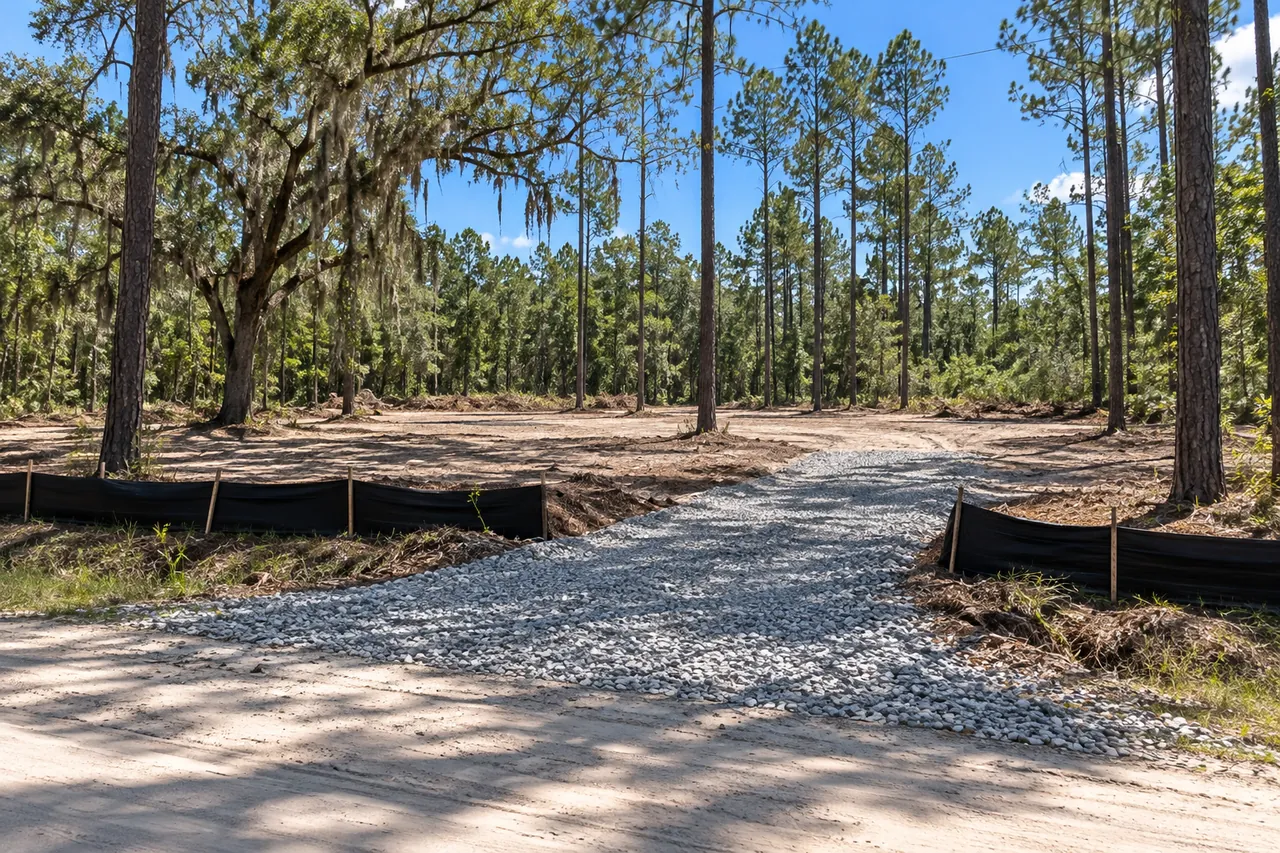
The order of operations
- Septic site first, if the lot won't be on sewer. The Florida Department of Health in Nassau County issues septic permits, and the site evaluation decides where the drainfield, and often the house, can go.
- Check for wet ground and flood zones. Cypress domes, bayheads and low edges may be regulated wetlands, and a flood zone changes the county's grading rules.
- Look for gopher tortoise burrows. Clearing for a house isn't covered by the FWC's farm and forestry exemption.
- Get the paperwork in order. In the Town of Callahan, a tree removal permit before any site work. In Hilliard, a town tree permit for trees that aren't exempt (all pines are). In unincorporated Nassau County, a building permit from the Building Department, (904) 530-6250, or the county's grading permit, depending on the job.
- Stake the layout. House, drive, well, drainfield and working room, with keeper trees flagged.
- Clear and grub only what the plan needs, then handle the debris.
- Fill and grade for drainage, and stabilize bare sand.
Septic and well setbacks come before the machine
The septic program moved to the Florida Department of Environmental Protection in 2021, but in Nassau County the permits are still issued by the Florida Department of Health in Nassau County. Its Environmental Health office is at 86014 Pages Dairy Road in Yulee, (904) 557-9150. The FDEP's permitting FAQ says the site evaluation "must be performed by a qualified professional."
State rule 62-6.005 keeps a septic system 75 feet from a private drinking-water well and 75 feet from the edge of surface water, and at least 5 feet from foundations and property lines. Ask DOH-Nassau whether any clearing is needed before the evaluation, and keep machines off the likely drainfield area until it's settled.
Water table, fill and the county's lot grading form
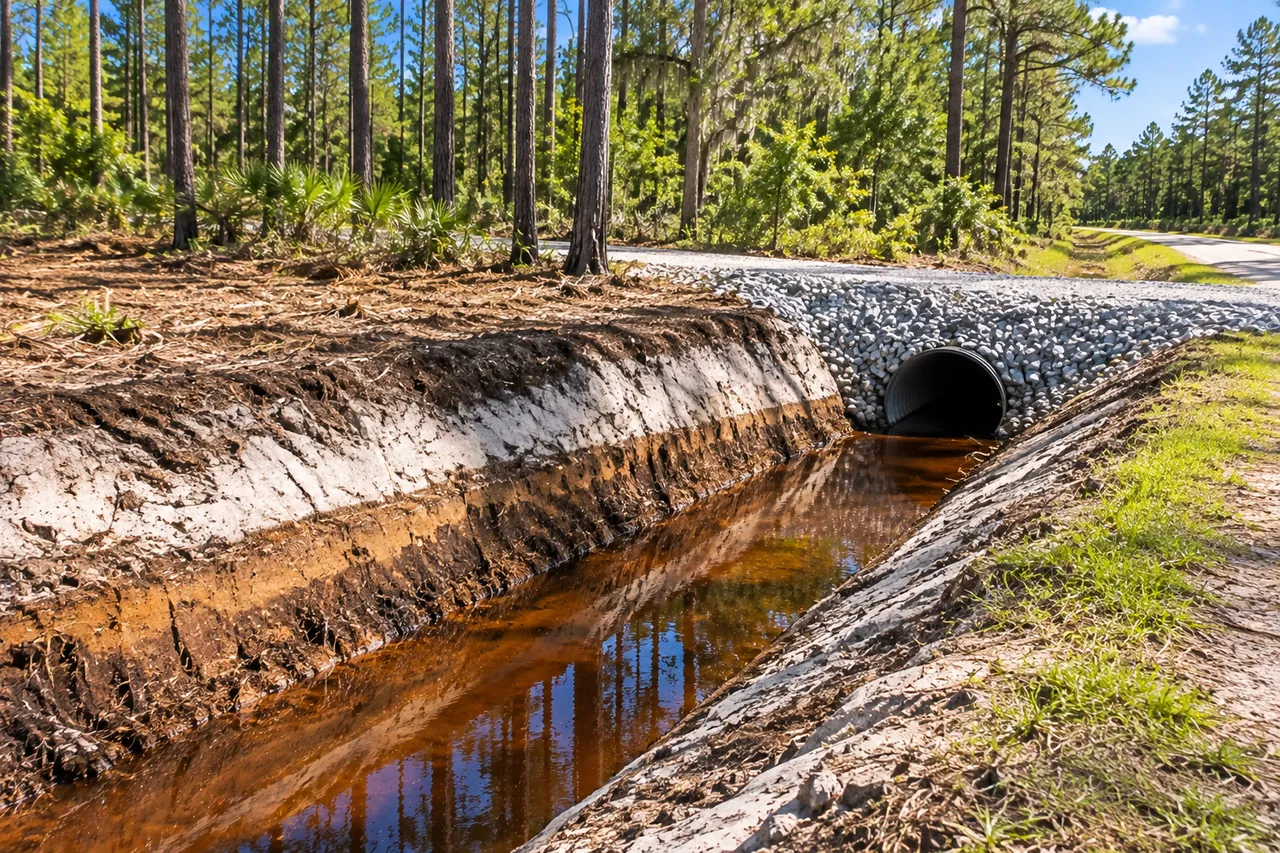
Much of this land is low and flat, with a water table that rises close to the surface for part of the year, and in many soils a dark hardpan layer that shows as a dark band in ditch cuts. Water pools after heavy rain. So drainage and fill come up on almost every house site, and the county's paperwork asks about both.
In unincorporated Nassau County, the Lot Grading Form (revised January 2024) makes the builder responsible for the drainage plan and says checking it "includes clearing or bringing in fill." It asks about fill within 10 feet of a property line, which "includes installation of mound septic systems and side slopes." In a FEMA AE flood zone, the finished floor must be at least one foot above the base flood elevation. Stormwater and Drainage handles these forms, (904) 530-6390, and the county's Floodplain Management office is at (904) 530-6410. Inside the Town of Callahan, the Zoning Administrator is the floodplain administrator, and fill in a flood hazard area must be "the minimum necessary to achieve the intended purpose."
Driveways and roadside ditches
Rural roads here typically drain into roadside ditches and swales, and a new drive crosses one on a culvert. Nassau County's right-of-way FAQ is plain: "All driveway and/or drainage connections to and/or across public right-of-way shall require a permit." The County Engineer decides the culvert pipe size and depth, permits last up to 12 months, and they're issued at the county offices at 96161 Nassau Place in Yulee. Inside Hilliard, the town code requires a permit before any culvert pipe goes in a public right-of-way; in Callahan, ask the town. Digging the crossing is excavation, so call Sunshine 811 first.
The one-acre line
If the work disturbs one acre or more, the state's Construction Generic Permit applies: a Notice of Intent at least 2 calendar days before work starts, a stormwater pollution prevention plan, and a $250 fee for 1 to 5 acres. A smaller job that's part of a larger plan of development can be covered too. Nassau's grading packet flags the same line for nonagricultural work. Clearing only the footprint, drive and septic area often keeps a house site under it.
Tortoises and wetlands
The FWC doesn't require a permit if every gopher tortoise burrow is avoided by 25 feet. Closer than that on a house site, the tortoises have to be relocated under permit before clearing, and the FWC's guidelines require a new survey if clearing doesn't start within 90 days of the last full survey. For anything wet, assume a cypress dome or bayhead is a wetland until an agency says otherwise. See wet lots and cypress domes and the permits guide.
What to do with the debris
- Mulch or grind on site. Works in any season and leaves usable mulch. Forestry mulching can clear the rest of the acreage around the footprint.
- Burn. Land-clearing piles need a Florida Forest Service authorization, at least 300 feet from occupied buildings other than yours for a home site and 100 feet from a paved public road. Inside the Town of Callahan, the town has to authorize it too. The burning guide has the rest.
- Never bury stumps under the pad or drive. Buried wood rots and the ground settles.
What lot clearing costs
Nationally, Angi's September 2026 figures put one acre at $500 to $2,000 if lightly forested and $3,600 to $5,600 if densely forested. For a quarter acre, roughly a house footprint with room to work, HomeAdvisor's June 2026 figures run $125 to $500 lightly wooded and $750 to $1,400 heavily forested. Angi's state table lists a Florida average of $3,890 per clearing project.
On these lots, fill, culvert work, debris handling, tortoise surveys and wet-season delays can matter as much as the trees. These are published national and statewide figures, not local prices. Your real figure comes from a contractor who has stood on the lot and put a price in writing. More on cost.
What commonly goes wrong
- Clearing before the septic evaluation, then finding the best drainfield spot is where the machines ran.
- Cutting in town without the tree permit. Callahan's after-the-fact permit is $500 per tree, plus $250 a day if it isn't applied for within 30 days. Hilliard can charge $100 per inch of diameter for a tree that's removed and not replaced.
- Running over a tortoise burrow or pushing debris into a cypress dome.
- Grubbing when the water table is up, leaving ruts full of dark water.
- Crossing the ditch without a driveway permit.
House site questions
Is it smart to clear before closing?
Rarely. Wait until you own the lot and the septic evaluation is done. Clearing first and then learning the drainfield has to sit right where the machines ran is an expensive way to find out the order matters.
How much should come out?
Plan on the house footprint, the driveway, the septic area, room for utility lines, and working space around the house. More can come out later. On a single lot that isn't part of a larger development, keeping disturbance under an acre also keeps the state construction permit out of the picture.
Can I keep the big live oak near the house site?
Often, if the grading and fill stay off its roots. Flag it, mark how close machines may go, and write that into the quote.
Who handles the permits?
It varies, so put in writing who files each permit and notice.
How we help
Phone or use the short form with the lot's location, its size, and whether the septic site has been evaluated yet. We hand the request to one independent contractor who prepares house sites in this part of Nassau County. They walk the land and give you a written quote, and you decide. There's no charge for the referral.
Want a local contractor to walk your land?
Call or send a short request. There's no charge for the referral.