
Forestry Mulching in Callahan, FL
Forestry mulching is one of the most practical ways to clear saw palmetto, gallberry and young pine on the flat, sandy land around Callahan, Hilliard, Bryceville and western Nassau County. One tracked machine grinds the understory where it stands and leaves it as a layer of chips, so there's no pile to burn and nothing to haul. Here's where it fits, what to check first (gopher tortoise burrows), how palmetto comes back, what it costs, and where permits come in.
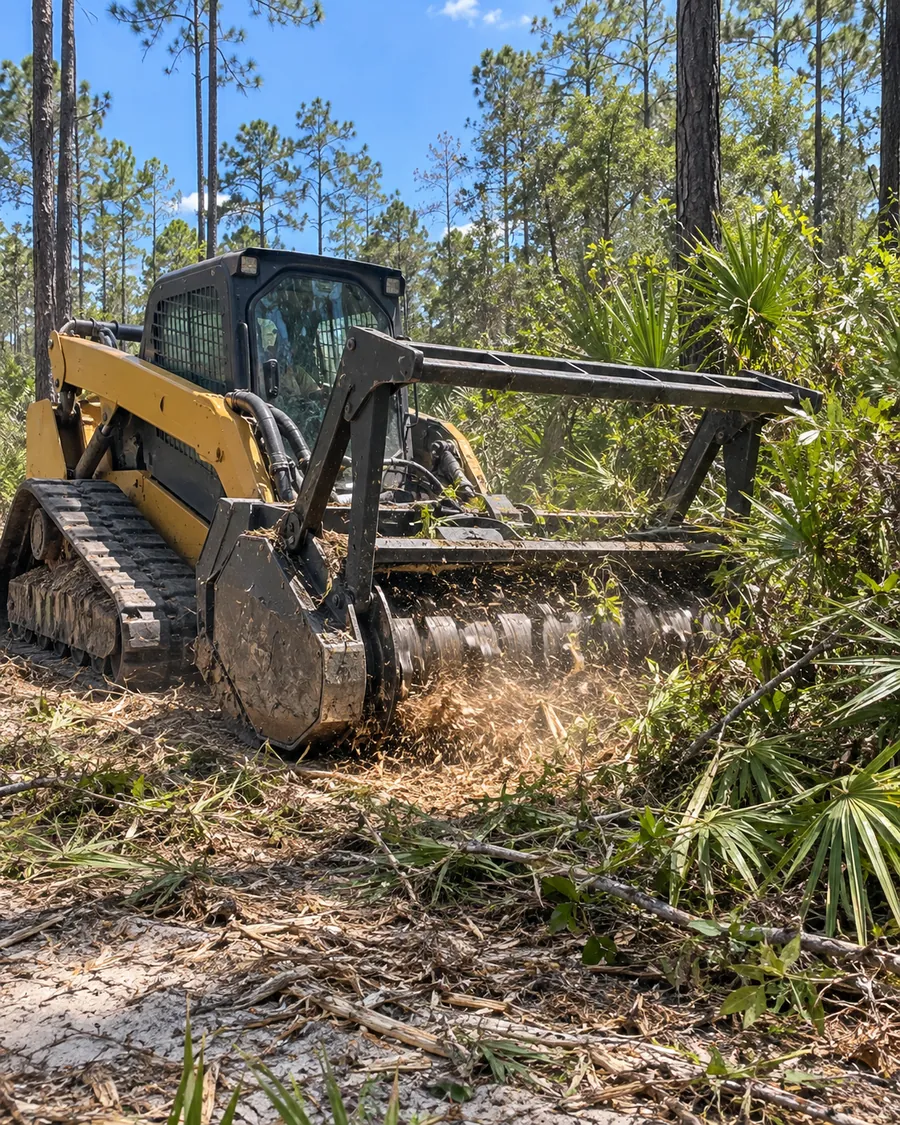
How a forestry mulcher works
The working end is a drum or disc studded with steel or carbide teeth, mounted on a compact track loader, skid steer, excavator or tracked carrier. The head chews standing growth down and drops the shreds in place: one person, one machine, usually one pass. Heads differ in how big a stem they can take, so ask each contractor what diameter theirs handles comfortably. Mature pines are usually left standing or cut and handled separately.
Why it suits flatwoods ground
Pine land covers much of this corner of Nassau County (about three-quarters of the county's farmland is woodland, per the 2022 Census of Agriculture), and the understory in the flatwoods is dense and low: saw palmetto, gallberry, fetterbush, staggerbush, wax myrtle and wiregrass. That kind of growth is exactly what a mulching head is built for.
- The pines can stay. On planted slash pine, an operator can mulch the palmetto between the rows and leave every tree standing.
- The sand stays covered. Cleared ground here is typically gray sandy topsoil over nearly white sand. Mulching leaves the roots in place and a mat on top instead of bare, loose sand.
- Wet ground is easier on a mat. The water table rises close to the surface for part of the year. A tracked machine riding on its own mulch layer carries better than wheels on bare sand, though it still has limits. See wet lots and cypress domes.
- Nothing to burn. Burning land-clearing piles takes a Florida Forest Service authorization and setbacks of 300 feet or more from other people's occupied buildings. Mulching skips all of that. More on burning.
Check for gopher tortoise burrows first
Gopher tortoises are listed as threatened in Florida, and their burrows are protected. Florida Fish and Wildlife Conservation Commission rule 68A-27.003 says no person shall "molest, damage, or destroy gopher tortoise burrows, except as authorized by Commission permit." A mulcher running over a burrow can collapse it.
- The 25-foot rule. Per the FWC's gopher tortoise FAQ, "an FWC permit is not required if all gopher tortoise burrows are avoided by 25 feet in all directions."
- Farm and forestry work is treated differently. The FWC says permits are not required for agricultural or silvicultural activities such as mowing, roller-chopping and tree-cutting. Clearing for a house or other development isn't covered by that exemption.
- Relocation is done by permit. If development clearing has to come within 25 feet of a burrow, the tortoises are relocated under an FWC permit first, usually by an Authorized Gopher Tortoise Agent. FWC staff don't relocate tortoises for private landowners.
- Indigo snakes. The eastern indigo snake is federally threatened, and the U.S. Fish and Wildlife Service's protection measures say that if one is seen, clearing stops until it moves off.
Walk the land first, flag any burrows, and show them to the operator. Questions go to the FWC's Northeast Region at (352) 620-7732. The permits guide covers surveys and permits in more detail.
Typical mulching jobs in western Nassau County
- Opening up the palmetto and gallberry under planted pines, leaving the canopy.
- Taking back fence lines and pasture edges where palmetto, wax myrtle and young pines have crept in. See pasture clearing.
- Cleaning up cutover after a pine harvest, where the understory starts resprouting right away.
- Clearing most of a wooded homesite before the house footprint is grubbed. See clearing a house site.
- Knocking down invasive plants as a first step before follow-up treatment; ask the Nassau County Extension office, (904) 530-6353, what works on yours.
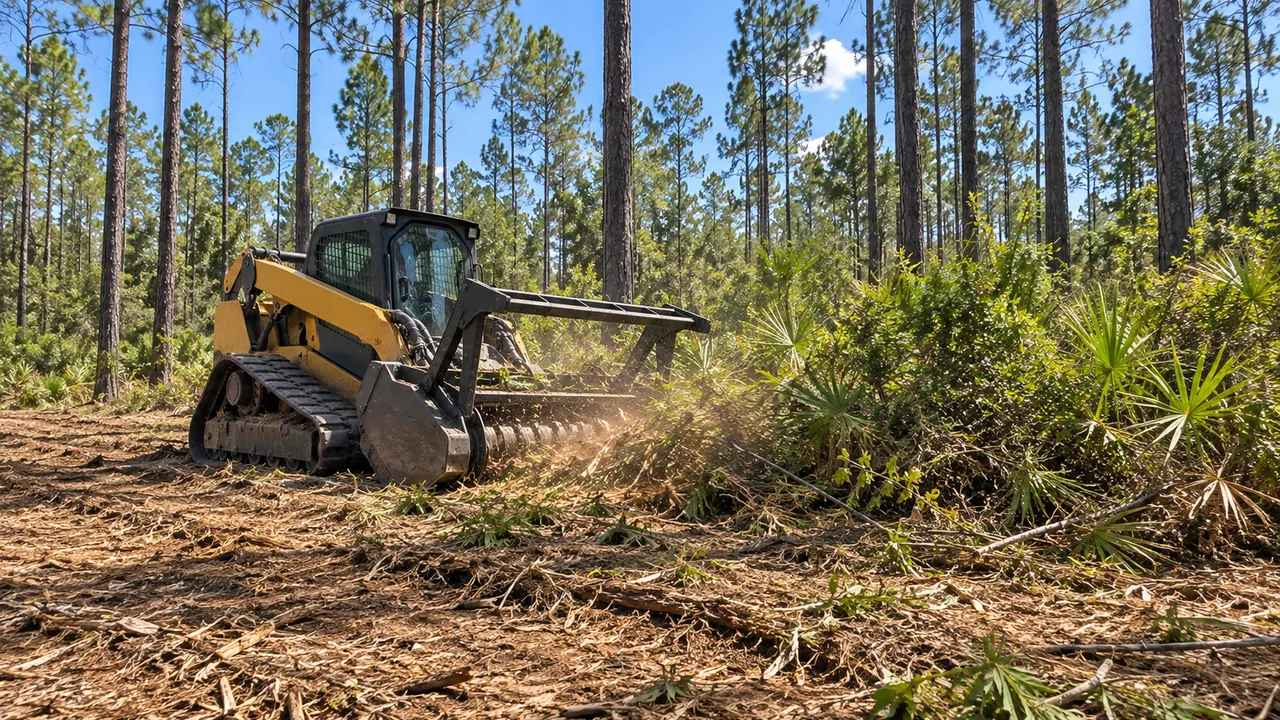
When mulching is the wrong tool
- Where something will be built. Mulching leaves roots behind, and as they decay the ground over them sinks. Slabs, driveway bases and drainfields need the stumps and roots excavated.
- In a cypress dome, bayhead or other wetland without checking first. State rule 62-330.020 requires an Environmental Resource Permit for any project "in, on, or over wetlands or other surface waters," whatever the machine.
- Within 25 feet of a tortoise burrow on a development job, until the permit work is done.
- Saturated ground. When ruts fill with tea-colored water, even tracked machines tear up the sand. Waiting is often cheaper.
Palmetto comes back
Saw palmetto sprouts right back after a fire. Expect regrowth after mulching as well: one pass resets the clock, it doesn't end the palmetto. Plan on follow-up: mowing, another mulching pass, herbicide on the worst areas, or prescribed fire where that's practical. The palmetto and underbrush guide compares those options.
What forestry mulching costs
Mulching is priced by the acre, the day or the machine hour. Nationally, HomeAdvisor's June 2026 figures run $400 to $1,500 per acre, with hourly rates of $125 to $200 for underbrush and small trees and $200 to $400 for heavy, dense brush. Angi's May 2026 figures run $1,000 to $2,500 per acre, or $150 to $300 an hour.
A worked example, with the assumption shown: if a contractor estimated two full days, 16 machine hours, on underbrush and small trees, HomeAdvisor's national $125 to $200 hourly range works out to $2,000 to $3,200 before any travel charge or minimum. Head-high palmetto and gallberry is not light brush, so don't read the low end of a national range as typical here.
What moves the number here: palmetto height and density, wet ground, pines to work around, any tortoise survey, and the trip out. These are national figures, not local prices. Treat them as reference points; the price to plan on is the one a contractor writes down after walking your acreage. More on cost.
Does mulching need a permit?
It depends where the land is and what it's for. Nassau County's tree-removal permit applies on unincorporated Amelia Island. On the mainland, ask the county what your project needs: its grading permit packet asks whether you're modifying surface features, in a flood zone, or near a stream or wetland, and Stormwater and Drainage, (904) 530-6390, can tell you how mulching fits. Inside the Town of Callahan, the tree chapter bars tree removal and site work for development before the Building Official issues a permit, so call (904) 879-3801 first. Hilliard requires a town permit to remove trees, though all pines and several other species are exempt; call Town Hall at (904) 845-3555. The permits guide has the details and links.
Forestry mulching questions
Can I plant grass through the mulch?
Through a thin layer, usually yes; a thick mat may need raking or disking first. The Nassau County Extension office, (904) 530-6353, can help with planting questions.
How many acres can be mulched in a day?
It depends on how dense the palmetto is, how wet the ground is and the size of the machine. Ask for an estimate of machine hours in the quote, and the rate if the job runs over.
Can the mulcher work near the cypress dome at the back of my land?
On the upland side, yes. In unincorporated Nassau County, the Land Development Code calls for an undisturbed natural upland buffer of 25 feet along wetlands, and never less than 15 feet, so flag that line and keep the machine outside it. Work inside the dome needs state review first. See wet lots and cypress domes.
I'm only clearing for pasture. Do tortoise rules apply?
The FWC doesn't require a permit for agricultural work such as mowing and roller-chopping. Clearing for a house or other development is a different matter. If you're not sure which your project is, ask the FWC's Northeast Region before the work starts.
How we help
Phone us or use the short form, and say where the land is, roughly how many acres, and how high the palmetto stands. Your request goes to one independent contractor who mulches land in western Nassau County. They walk the land and give you a written quote, and you decide. There's no charge for the referral.
Want a local contractor to walk your land?
Call or send a short request. There's no charge for the referral.