
Stump Grinding and Removal in Callahan, FL
Stump grinding around Callahan, Hilliard, Bryceville and western Yulee usually means pine stumps in sandy yards, pastures and house sites. You can grind a stump below grade and leave the roots, or dig the whole thing out, and the right choice depends on what goes on that spot next. Here's how each works in this sand, why Sunshine 811 gets a call before a grinder touches the ground, how to protect septic and well lines, and what grinding runs by the national guides.
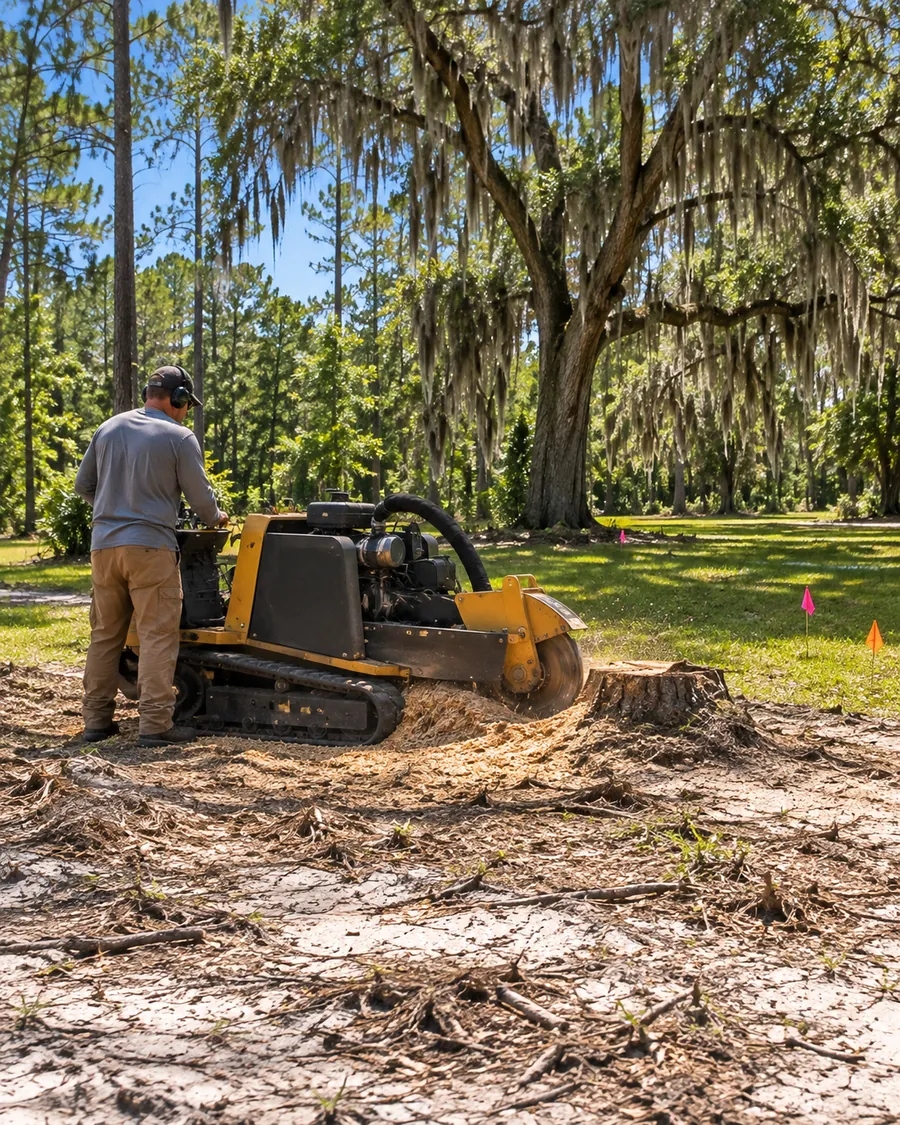
Grinding or removal?
- Grinding chews the stump down to chips with a toothed wheel, from a walk-behind grinder for a yard to a larger self-propelled or towed machine. The roots stay in the ground and rot slowly. It's the usual choice for a lawn, a pasture or anywhere you'll mow.
- Removal means an excavator digs out the stump and its root ball. It leaves a hole to fill but nothing to rot later. It's the right call under a slab, a driveway, a shop floor or anything else that can't settle.
Before anyone starts, agree in writing how far below grade the grinder will go, how wide around the stump, and what happens to the chips. "Grind the stumps" can mean very different things to two people.
Stumps in sandy flatwoods
Cleared ground here is gray sandy topsoil over light gray to almost white sand, with no rock at the surface, and often a dark hardpan layer not far down. The water table can rise close to the surface for part of the year. Two practical results:
- Dug-out stump holes can fill with water in wet months. Fill them with sand compacted in layers, not with grindings or brush, or the spot will sink.
- Grindings settle too. A ground-out stump hole backfilled with its own chips will slowly sink as the wood breaks down. For a smooth lawn, rake most of the chips out and fill with sand or soil.
Call Sunshine 811 first
Florida's underground facility law (§ 556.105, F.S.) requires notice "not less than 2 full business days before beginning any excavation," and a locate is good for 30 calendar days. Its definition of excavation includes work "intended to penetrate or disturb the surface of the earth" (§ 556.102). It doesn't name stump grinding, but grinding below grade does exactly that, so call 811 first. The homeowner exemption in § 556.108 covers a single-family owner digging on their own land only to a depth of 10 inches.
Call 811 or (800) 432-4770, or submit a ticket through Sunshine 811. Sunshine 811 doesn't mark lines itself; the member utilities or their locators do. The flags cover their lines, so your own well line, septic pipes and any power run to a barn or pump are yours to point out to the operator.
Near septic systems and wells
If your home is on a well and septic system, keep in mind that a grinder's wheel, or an excavator pulling a stump, can break a pipe it can't see. Mark the septic tank, the drainfield and the line from the well to the house before work starts, and keep heavy equipment off the drainfield. If you aren't sure where your system is, the Florida Department of Health in Nassau County's Environmental Health office, (904) 557-9150, handles septic permits in the county.
What stump grinding costs
HomeAdvisor's June 2026 national figures put the average stump grinding job at $250, with a normal range of $120 to $500. Professionals charge "between $2 and $5 per inch of diameter," many have "a minimum fee of $100 to $150 for a single stump," and "additional stumps may cost just $40 to $75 each."
Putting those numbers to work: a single 18-inch pine stump at $2 to $5 an inch is $36 to $90, which is under the $100 to $150 minimum many contractors charge, so one stump that size usually costs the minimum. Ten stumps, priced as a first stump at $100 to $150 plus nine more at $40 to $75 each, comes to $460 to $825. Digging stumps out is usually quoted by the hour or the job. Those are national figures, not local prices, so count on the written price from whoever actually looks at your stumps. More on cost.
When a stump grinder isn't the right tool
- A whole tract of stumps, such as cutover going to pasture, is usually priced by the hour or day with bigger equipment. See clearing after logging and pasture clearing.
- A house site needs stumps out of the footprint and drive, not ground. See clearing a house site.
- Brush and small trees with low stumps are often handled by a forestry mulcher in the same pass. See forestry mulching.
Does stump work need a permit?
Grinding an old stump isn't tree removal. Cutting down the tree in the first place can be: inside the Town of Callahan, tree removal tied to development needs a permit from the Building Official, (904) 879-3801, and Hilliard requires a town permit to remove trees that aren't exempt (all pines are), (904) 845-3555. The permits guide has the details.
Stump questions
How deep should a stump be ground?
Deep enough for what comes next. For grass, ask for enough depth to cover the spot with a few inches of sand or soil, with the chips raked out. For planting a new tree in the same spot, go deeper. Put the depth in the quote.
Do I really need an 811 ticket for one stump?
Call. It's a phone call or an online ticket, and a broken line costs far more than two business days.
What happens to the grindings?
Leave them as mulch, rake them into beds, or have them hauled. Don't use them to fill the hole where you want a level lawn.
Grind or pull the stumps on a new house site?
Pull them where the house, drive and any slab or pad will go, and grind them in the yard areas. Keep both off the drainfield site.
How we help
Say how many stumps there are, about how wide, and where on the property they sit. We route your request to one independent contractor who grinds and pulls stumps around Callahan. They look at the job and give you a written quote, and you decide. There's no charge for the referral.
Want a local contractor to walk your land?
Call or send a short request. There's no charge for the referral.