
Land Clearing Permits, Wetlands & Burn Rules in Nassau County, FL
Do you need a permit to clear land around Callahan, Hilliard or Bryceville? It depends first on where the land is: inside the Town of Callahan, inside the Town of Hilliard, or in unincorporated Nassau County. Then it depends on what you're doing: clearing for a house or for farming and forestry, working near wet ground, burning the debris, or digging. Gopher tortoises add a rule of their own. Here's each rule in plain terms, with thresholds, fees, the office that decides and its phone number, checked against town code, county forms and state rules in October 2026. Codes get amended, so follow the links and confirm before relying on any of it.
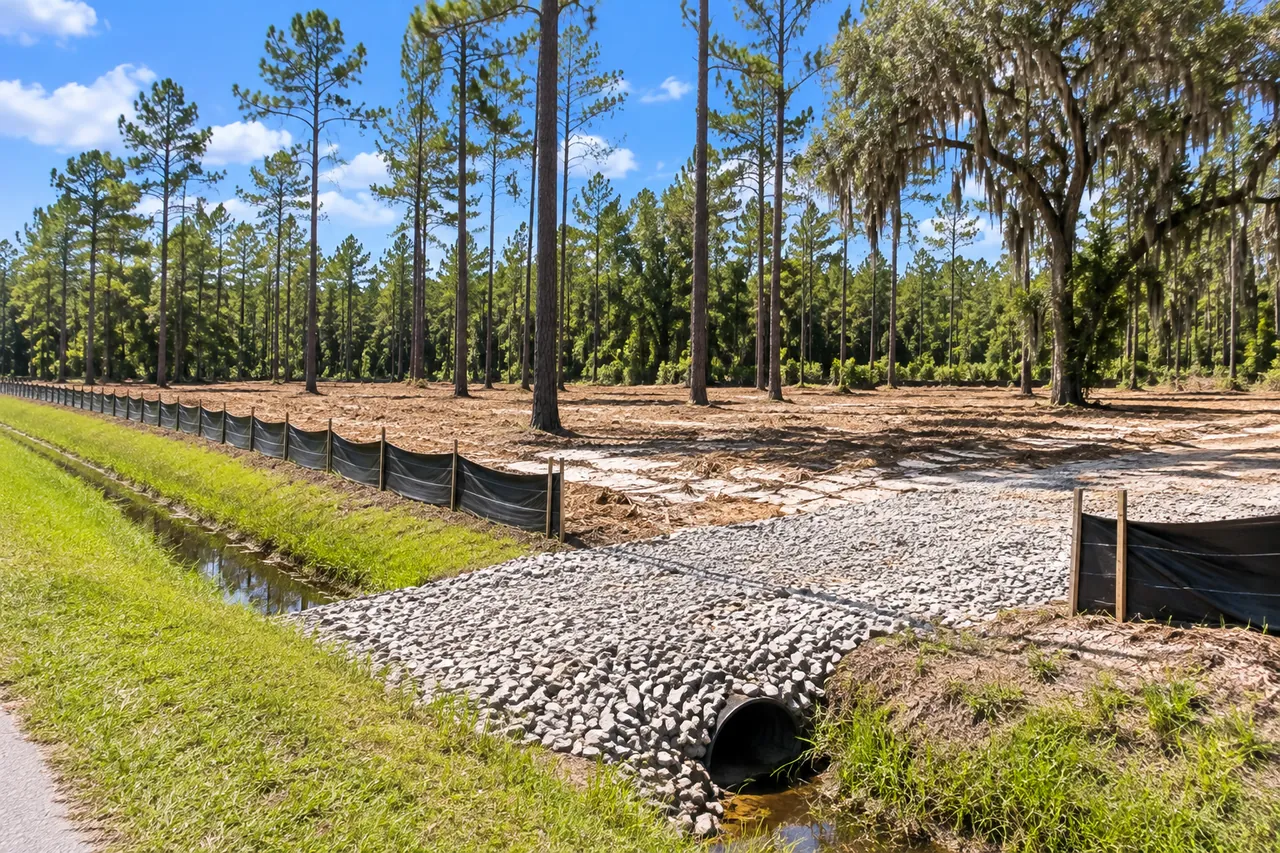
The short version
| If you're... | Then... |
|---|---|
| Clearing for development inside the Town of Callahan | A tree removal permit from the Building Official before any site work or tree removal. No fee if you get it first; $500 per tree after the fact. |
| Removing trees inside the Town of Hilliard | A town tree permit, unless the tree is exempt (all pines are). Trees removed and not replaced can carry a $100-per-inch fee. Cutting in a town right-of-way takes a $1,000 cash deposit. |
| Grading or otherwise changing the ground's surface in unincorporated Nassau County without a building permit (the county also flags flood zones and land near wetlands or streams) | A county grading permit from Stormwater and Drainage, (904) 530-6390. |
| Disturbing one acre or more (not for agriculture) | State Construction Generic Permit coverage from the FDEP, filed at least 2 days before work. |
| Working in, on or over a wetland, cypress dome or creek | A state Environmental Resource Permit, a check on federal jurisdiction, and in the county a 25-foot upland buffer. |
| Clearing for development within 25 feet of a gopher tortoise burrow | An FWC permit, with the tortoises relocated before clearing. |
| Crossing a roadside ditch with a new driveway | A right-of-way permit from the county or town. |
| Burning land-clearing debris | A Florida Forest Service authorization and setbacks of 300 feet or more; in Callahan, town authorization too. |
| Putting in a septic system | A permit from the Florida Department of Health in Nassau County. |
| Grinding stumps or digging | A Sunshine 811 ticket at least 2 full business days ahead. |
First question: where is your land?
The Towns of Callahan and Hilliard have their own tree rules, and Callahan has its own burning rules too. Everything else this site covers, including Bryceville, western Yulee and the rural land between, is unincorporated Nassau County, where county and state rules apply. Amelia Island, including Fernandina Beach, isn't covered here: Nassau County's tree removal permit applies "within the unincorporated portion of Amelia Island." On the mainland, ask the county what your project needs. If you're not sure whether your land is inside a town, ask the town hall before you plan the work.
Clearing and grading: Town of Callahan
Callahan's tree ordinance, Chapter 166, covers development that needs a town permit or authorization. Under § 166-5, "No development activity or site work shall begin and no trees may be removed" until the Building Official issues a tree removal permit, and the first development permit application must include a survey of all trees on the parcel. A tree, for this chapter, has a single trunk at least two feet tall and "a diameter at two feet above the ground of at least two inches." Removal "in anticipation of development" counts, even by a previous owner.
- Fees: none if the permit is obtained before removal. An after-the-fact permit is $500 per tree, and not applying within 30 days brings a $250-per-day fine (§ 166-7). Appeals go to the Town Council.
- Site plans: under the zoning code (Chapter 195), a site plan is required before construction other than single-family homes and duplexes.
- Flood zones: under Chapter 110, filling and grading in a flood hazard area need a permit from the floodplain administrator, who is the Town Zoning Administrator.
Who to call: the Building and Zoning Administrator, 542300 US Hwy 1, (904) 879-3801. The town's permits page notes that "some permits can take up to 48 Hours," and its code page warns that the posted code may not be current, so confirm before you cut.
Clearing and grading: Town of Hilliard
Hilliard's code makes it unlawful to "cut down, destroy, remove or move, or effectively destroy through damaging any tree located on any property without obtaining a permit" (Sec. 62-570(b)). Removal includes damage to the root system "by heavy machinery" and "changing the natural grade above the root system."
- Exempt trees (Sec. 62-571): "All pines," plus pecan, black cherry, cherry laurel, chinaberry, Chinese tallow, camphor, American mulberry and several others.
- Replacement (Sec. 62-574): for removal to build, live oaks are replaced inch for inch and other trees over 12 inches in diameter at one-third of the total caliper removed.
- Mitigation fee (Sec. 42-12): $100 per inch of diameter, measured at 4.5 feet, for trees removed and not replaced.
- Right-of-way trees (Sec. 42-2): property owners may cut trees on their own property, but removing trees in a town right-of-way takes an application to the town clerk and a $1,000 cash deposit, with ditches and culverts cleared within 20 days of the last cut. The town's tree cutting and harvesting application (form dated May 2024) asks for the same deposit. That section doesn't apply to a bona fide farm on land classified as agricultural.
- Culverts: no culvert pipe in a public right-of-way without a permit (Sec. 42-31).
The code also exempts one- and two-family homes from its landscape requirements, but it isn't clear whether that covers the tree permit. Call Town Hall, 15859 West County Road 108, (904) 845-3555, before clearing in town limits.
Clearing and grading: unincorporated Nassau County
The county's Grading Permit Packet (revised January 2024) asks four questions: are you performing construction activities, defined as "Any activity which results in the modification of surface features, including but not limited to grading"; are you in a Special Flood Hazard Area; are you near a stream, wetlands or potential wetland; and are you on the island. "If YES to any of the above questions and you are not pulling a building permit or going through the Development Review Committee Process, this permit is needed." The packet's definition of agriculture includes forestry, and it notes best management practices are still recommended.
For new homes, the Lot Grading Form makes the builder responsible for drainage and says checking it "includes clearing or bringing in fill." In AE flood zones the finished floor must be at least one foot above the base flood elevation.
Who to call: Stormwater and Drainage, 96161 Nassau Place, Yulee, (904) 530-6390, for grading and lot grading. The Building Department, same address, (904) 530-6250. Floodplain Management, (904) 530-6410.
One acre or more: the state construction permit
The FDEP's Construction Generic Permit covers construction that will "Disturb at least one or more acres of land," and smaller sites that are part of a larger common plan of development or sale. Coverage comes from a Notice of Intent filed "at least 2 calendar days before commencement of construction activities," with a stormwater pollution prevention plan. The fee is $250 for 1 to 5 acres and $400 for 5 acres or more, and coverage lasts five years or until it's ended. Nassau's packet ties this to "Nonagricultural disturbance over an acre." FDEP Northeast District, Jacksonville: (904) 256-1700.
Driveways across roadside ditches
Nassau County's right-of-way FAQ: "All driveway and/or drainage connections to and/or across public right-of-way shall require a permit." The County Engineer sets the culvert size and depth, the permit is good for up to 12 months, and permits are issued at 96161 Nassau Place in Yulee. Hilliard requires its own culvert permit; in Callahan, ask the town.
Water, wetlands and flood zones
State permits. Under rule 62-330.020(2), an Environmental Resource Permit is needed for "Any project in, on, or over wetlands or other surface waters," for more than 4,000 square feet of impervious and semi-impervious surface subject to vehicle traffic, more than 9,000 square feet of impervious and semi-impervious surface in total, or a total project area over five acres. In Nassau County, ERPs come from the St. Johns River Water Management District or, for some projects such as a single-family home, the FDEP (Northeast District, (904) 256-1700). The District's nearest office is the Jacksonville Service Center, 7775 Baymeadows Way, (904) 730-6270, and headquarters in Palatka is (386) 329-4500. The District lists general permits for work in isolated wetlands on single-family lots, and the FDEP's single-family handout describes a verification of exemption for a home built entirely on uplands.
Farming and forestry. Florida's agricultural exemption (§ 373.406(2)) lets a person engaged in agriculture or silviculture alter the land consistent with normal practice, but not "for the sole or predominant purpose of impeding or diverting the flow of surface waters or adversely impacting wetlands." Silvicultural roads, crossings and culverts use a no-fee noticed exemption (rule 62-330.0511), filed before work.
Federal permits. The Army Corps of Engineers' Jacksonville District reviews federal wetland permits in Florida, (904) 232-2568. UF/IFAS's FE606 notes that the federal exemptions for normal farming and forestry don't cover "mechanized land clearing." Confirm jurisdiction before clearing wet ground.
County buffer. Nassau's grading packet quotes Land Development Code Section 37.03: "A minimum undisturbed natural vegetative upland buffer of twenty-five (25) feet shall be required and maintained," and "In no instance shall the upland buffer be less than fifteen (15) feet," except next to unavoidable impacts such as road crossings.
Flood zones. In the unincorporated county, a Special Flood Hazard Area is a grading permit trigger; Floodplain Management, (904) 530-6410. In Callahan, the Zoning Administrator, (904) 879-3801. Wet lots and cypress domes covers how this plays out on the ground.
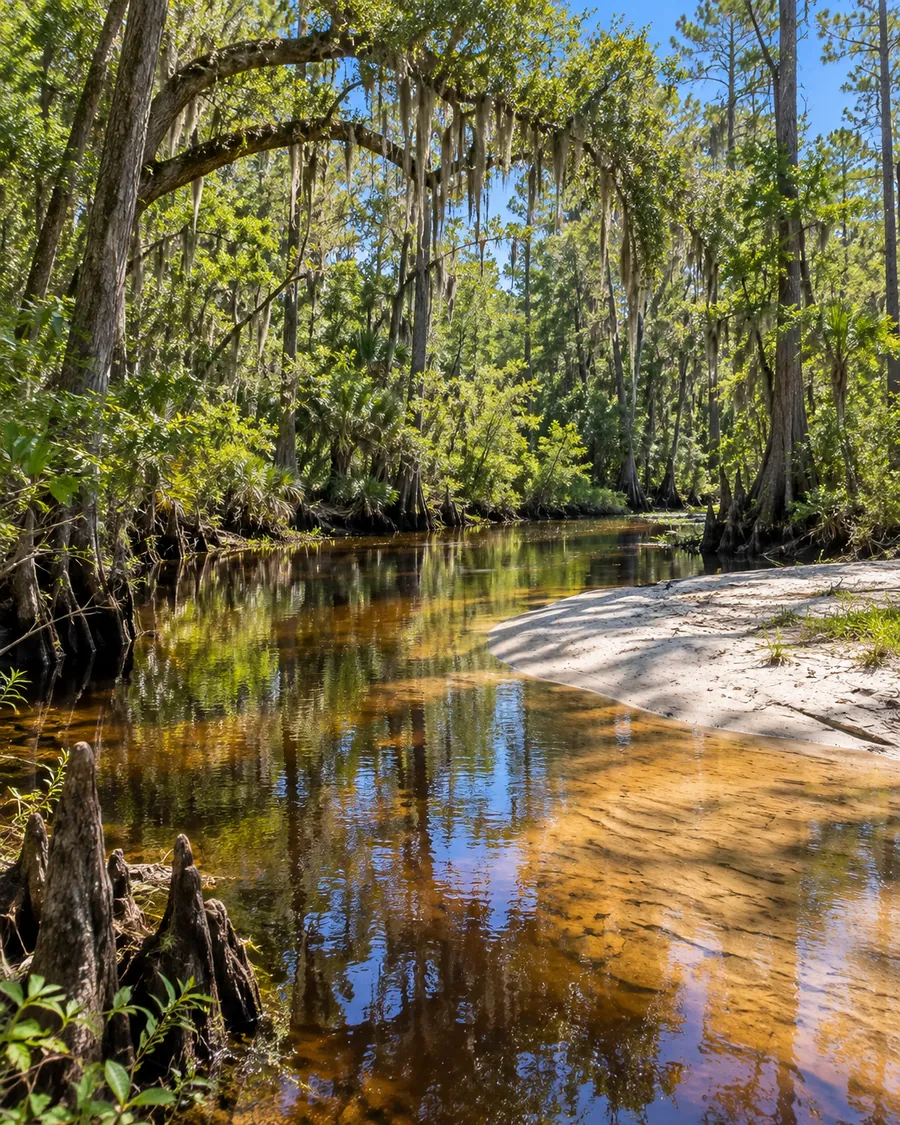
Gopher tortoises and eastern indigo snakes
Gopher tortoises are a state-threatened species, and FWC rule 68A-27.003 bars anyone from harming them or their burrows "except as authorized by Commission permit."
- The 25-foot rule: "an FWC permit is not required if all gopher tortoise burrows are avoided by 25 feet in all directions" (FWC FAQ). You can still be held responsible if your work collapses a neighbor's burrow within 25 feet.
- Development clearing: landowners must get a permit and relocate tortoises before clearing within 25 feet of a potentially occupied burrow (disturbed-site permits).
- Farming and forestry: no permit is needed for agricultural or silvicultural activities such as mowing, harvesting, prescribed burning, disking, roller-chopping and tree-cutting.
- Surveys: under the FWC's permitting guidelines (April 2023), if clearing doesn't start "within 90 days of most recent 100% gopher tortoise survey," the site has to be re-surveyed. On disturbed sites, a 28-day wait without further disturbance comes before burrow surveys.
- Who moves them: relocation is done by Authorized Gopher Tortoise Agents, and FWC staff don't relocate tortoises for private citizens. Under the 10 or Fewer Burrows permit, owners may relocate on their own site after registering online and passing the e-Learning course, with at least 750 square feet of suitable habitat for the tortoises.
FWC Northeast Region, which covers Nassau: (352) 620-7732. Gopher Tortoise Program: (850) 921-1030; permitting help: (850) 921-1031. The eastern indigo snake is federally threatened; the U.S. Fish and Wildlife Service's standard measures say to stop clearing and let a snake move away, and not to handle it. USFWS North Florida Field Office: (904) 731-3336.
Burning
Land-clearing, agricultural, silvicultural and pile burning need a Florida Forest Service authorization. Under rule 5I-2.006, residential and farm or forestry piles sit 300 feet from occupied buildings other than the landowner's, other land-clearing piles 1,000 feet unless an air curtain incinerator is used, and land-clearing, farm and forestry piles 100 feet from paved public roads. Yard waste from your home in a pile under 8 feet across needs no authorization but has its own setbacks. Burn authorization line, FFS Jacksonville District (serving Nassau from Bryceville): (904) 266-8351. Inside Callahan, Chapter 78 also requires town authorization and a Fire Chief's permit. Hilliard's code has no separate burning section, so the state rules apply; check with Town Hall first. The county can declare a burn ban, so check before burning. The burning guide has the full rules.
Septic systems and wells
Septic permits in Nassau County come from the Florida Department of Health in Nassau County, Environmental Health, 86014 Pages Dairy Road, Yulee, (904) 557-9150, which also handles private wells. Per the FDEP's FAQ, the site evaluation "must be performed by a qualified professional." Rule 62-6.005 keeps systems 75 feet from a private drinking-water well and from surface water, and 5 feet from foundations and property lines. Ask DOH-Nassau whether a lot needs any clearing before the evaluation.
Timber and forestry
Florida adopts its Silviculture Best Management Practices manual by rule 5I-6.002. It sets special management zones along streams, lakes and sinkholes where mechanical site preparation isn't done, and says not to do bedding, raking and windrowing in wetlands. The same manual says it isn't meant for land clearing associated with development, which other permits govern. The Florida Forest Service's County Forester for Nassau, (904) 845-7238, helps landowners with forestry questions, including what zone widths apply on your tract. Clearing after logging covers cutover.
Utilities: Sunshine 811
Under § 556.105, F.S., notice is required "Not less than 2 full business days before beginning any excavation or demolition," and a locate is valid for 30 calendar days. The exemptions in § 556.108 include a single-family owner digging on their own land only to 10 inches deep, and normal agricultural activities off marked rights-of-way and easements. Stump grinding isn't named in the law, but grinding below grade disturbs the earth's surface, so call first: 811 or (800) 432-4770, or Sunshine 811 online.
Permit questions
Do I need a permit to cut a few trees in my yard?
In Hilliard, yes, unless the trees are exempt (all pines are); ask whether the town's exemption for one- and two-family homes covers your lot. In Callahan, the tree chapter applies to development that needs a town permit, so ask the town. Nassau County's tree-removal permit applies on unincorporated Amelia Island; on the mainland, ask the county what your project needs.
Who pulls the permits, me or the contractor?
It depends on the permit. Builders and clearing contractors often handle the forms, but some need the owner. FFS burn authorizations go to whoever is burning. Put in writing who files what.
What happens if I clear without a permit?
In Callahan, $500 per tree after the fact and a $250-a-day fine if you don't apply within 30 days. In Hilliard, removing a non-exempt tree without a permit is unlawful (Sec. 62-570(b)), and trees removed and not replaced can carry a $100-per-inch fee. Harming tortoise burrows is a state wildlife violation; the FWC's Wildlife Alert line is (888) 404-3922. A phone call first costs nothing.
Does clearing for pasture or timber need permits?
Fewer of them. Farming and forestry have exemptions for tortoises and some water rules, and the county packet treats forestry as agriculture. Wetlands, burning and town tree rules still apply. See pasture clearing.
How we help
Call or use the form, and note whether the land is inside a town, near water, or has tortoise burrows. Your request goes to one independent contractor who works around Callahan, Hilliard and Bryceville. They walk the land and give you a written quote, and you decide. There's no charge for the referral. This page is general information, not legal advice; the town, county and state offices above have the final word.
Want a local contractor to walk your land?
Call or send a short request. There's no charge for the referral.