
Clearing Land After Logging in Nassau County, FL
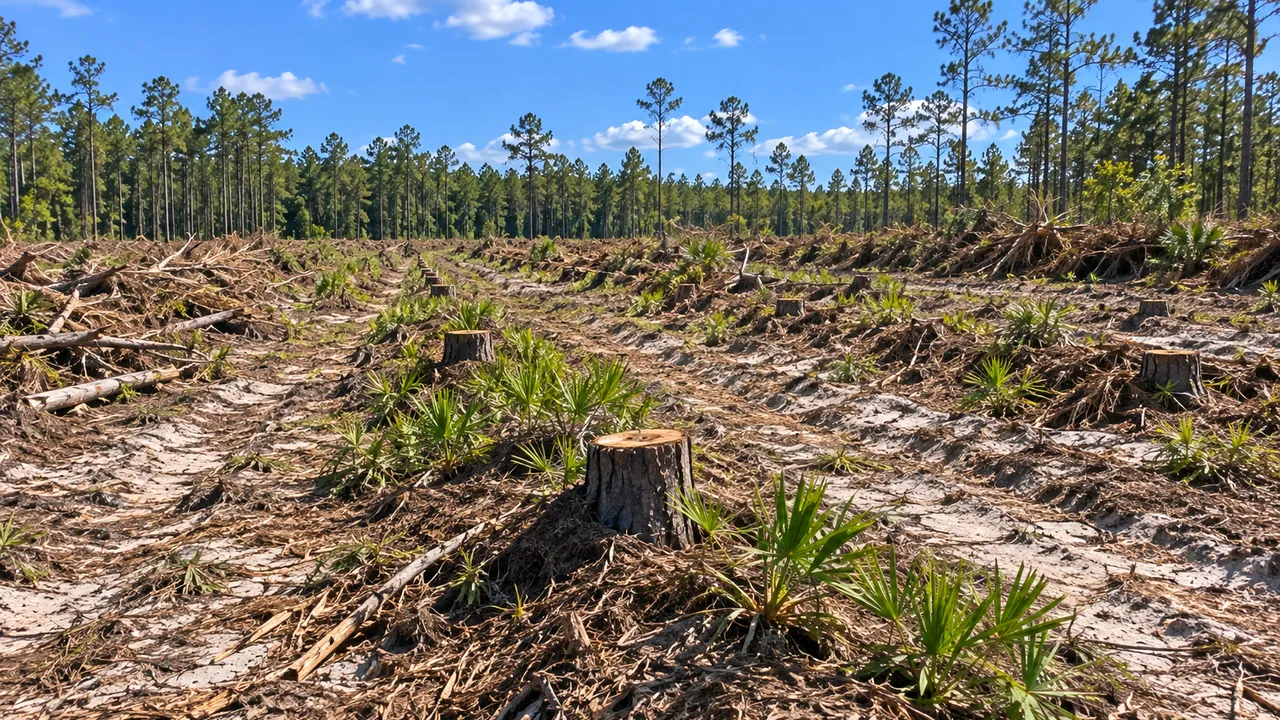
After a pine harvest in western Nassau County, the tract is often left with low stumps on raised planting beds, windrows of tops and limbs, and palmetto and gallberry coming back fast. Clearing land after logging starts with one decision: is it going back to pines, becoming pasture, or becoming a homesite? Each takes a different kind of cleanup and falls under different rules. Here's what cutover around Callahan, Hilliard and Bryceville looks like, how to handle it for each plan, and who can help.
What cutover looks like here
Slash pine is the main plantation pine in this part of Florida, planted in long, straight rows on low raised beds. After harvest, the stumps sit on those beds, the low furrows between them can hold water in wet months, and the tops and limbs are often pushed into long windrows. Gray sand shows between the rows, and the understory, mostly saw palmetto and gallberry, starts coming back quickly. The longer a tract sits, the thicker that regrowth gets and the more the cleanup costs.
Decide what the land is for first
- Back to pines. This is forestry. The stumps and beds can stay, the windrows can often stay, and the work is site preparation for replanting. Florida's forestry best management practices apply, and the FWC's gopher tortoise permits don't, because silvicultural work is exempt. The Florida Forest Service's County Forester for Nassau, (904) 845-7238, helps landowners plan this.
- Pasture. The beds have to be leveled, stumps removed or ground, and roots and debris raked off before planting. See pasture clearing.
- A homesite. This is clearing for development, and the rules change: tortoise surveys and permits, septic first, and town or county permits. See clearing a house site. Florida's silviculture manual says its practices are "not intended for use during tree removal or land clearing operations associated with development."
Streams, wetlands and the forestry rules
Florida adopts its Silviculture Best Management Practices manual by rule 5I-6.002. It sets special management zones along streams, lakes and sinkholes, where mechanical site preparation is not done. On wet ground, the manual says not to do intensive mechanical site preparation "such as bedding, raking and windrowing in wetlands," and to arrange windrows and soil beds parallel to a waterbody or wetland.
That matters here, with blackwater creeks and cypress domes scattered through the pine land. Four Creeks State Forest, about 10,959 acres between Callahan and Yulee, is named for Alligator (Mills), Thomas, Boggy and Plummer creeks, which form the headwaters of the Nassau River. The St. Marys River runs along the county's north and west edge. If a creek, cypress dome or bayhead touches your tract, ask the County Forester what zone widths apply before any machine work. For roads, crossings and culverts on forestry land, the state's no-fee noticed exemption (rule 62-330.0511) requires filing a notice of intent first and following the BMP manual.
Windrows and debris
- Mulch them. A forestry mulcher can grind windrows and scattered tops in place, which frees the ground and leaves nothing to burn. See forestry mulching.
- Burn them. Silvicultural and land-clearing pile burning needs a Florida Forest Service authorization, issued one day at a time for burners who aren't certified. State rule 5I-2.006 sets agricultural and silvicultural piles back 300 feet from occupied buildings other than the landowner's, 100 feet from paved public roads, and 50 feet from wildlands and brush, and the fire must be attended at all times. The burn authorization line for the FFS Jacksonville District, which covers Nassau County, is (904) 266-8351. See burning clearing debris.
- Leave them. On land going back to pines, windrows are often left to break down, though they take ground out of planting.
Stumps on the beds
For replanting, stumps generally stay. For a mowed pasture or a yard, they need to be ground below grade or pulled, and the beds leveled. Pulled stumps leave holes that can fill with water when the water table is up, so they need filling with compacted sand. See stump grinding and removal for the trade-offs.
Gopher tortoises and indigo snakes
The FWC's FAQ lists harvesting, tree-cutting, roller-chopping, disking and prescribed burning among the forestry and farm activities that don't need a gopher tortoise permit. Converting cutover to a homesite or other development is not exempt, and the 25-foot rule and permits apply. The U.S. Fish and Wildlife Service's protection measures for the eastern indigo snake say to stop and let a snake move off if one is seen. FWC Northeast Region: (352) 620-7732.
Town rules
Inside Hilliard, the town tree permit exempts all pines, but cutting trees in a town right-of-way takes an application and a $1,000 cash deposit, and ditches and culverts must be cleared within 20 days after the last cut (Town Hall, (904) 845-3555). Inside Callahan, the tree chapter applies to development that needs a town permit, (904) 879-3801. The permits guide has the details.
What cleanup costs
Published figures for cutover specifically are scarce. Angi's September 2026 national figures put clearing at $500 to $5,600 per acre, with land clearing pros typically charging $110 to $250 an hour. HomeAdvisor's June 2026 national figures put forestry mulching at $400 to $1,500 per acre. What moves the number on cutover: how long it's been since harvest, how big the windrows are, whether stumps and beds have to go, and wet furrows. Budget from a written quote by someone who has been over the tract, not from these averages. More on cost.
Cutover questions
The logger left windrows and tops everywhere. Is that normal?
Often, unless the timber sale contract said otherwise. If you'll sell timber again, write cleanup terms into the contract: what happens to tops, where windrows go, and how roads and ditches are left.
How soon should I clear after a harvest?
Sooner is usually cheaper. Palmetto and gallberry resprout right away, and young growth is easier to mulch or mow than a few years of it.
Can I build on cutover right away?
Yes, once the septic site is evaluated, any gopher tortoise survey is done, and the town or county permits are in hand. Clearing for a house is development, not forestry.
Is there help with replanting?
Start with the County Forester, (904) 845-7238. The USDA Natural Resources Conservation Service's EQIP program also offers financial and technical assistance to forest landowners through the local USDA Service Center.
How we help
Give us the tract's location, acreage, harvest date, and what you'd like it to become. Your request goes to one independent contractor who handles cutover cleanup around Callahan, Hilliard and Bryceville. They walk the land and give you a written quote, and you decide. There's no charge for the referral.
Want a local contractor to walk your land?
Call or send a short request. There's no charge for the referral.