
Pasture Clearing in Nassau County, FL
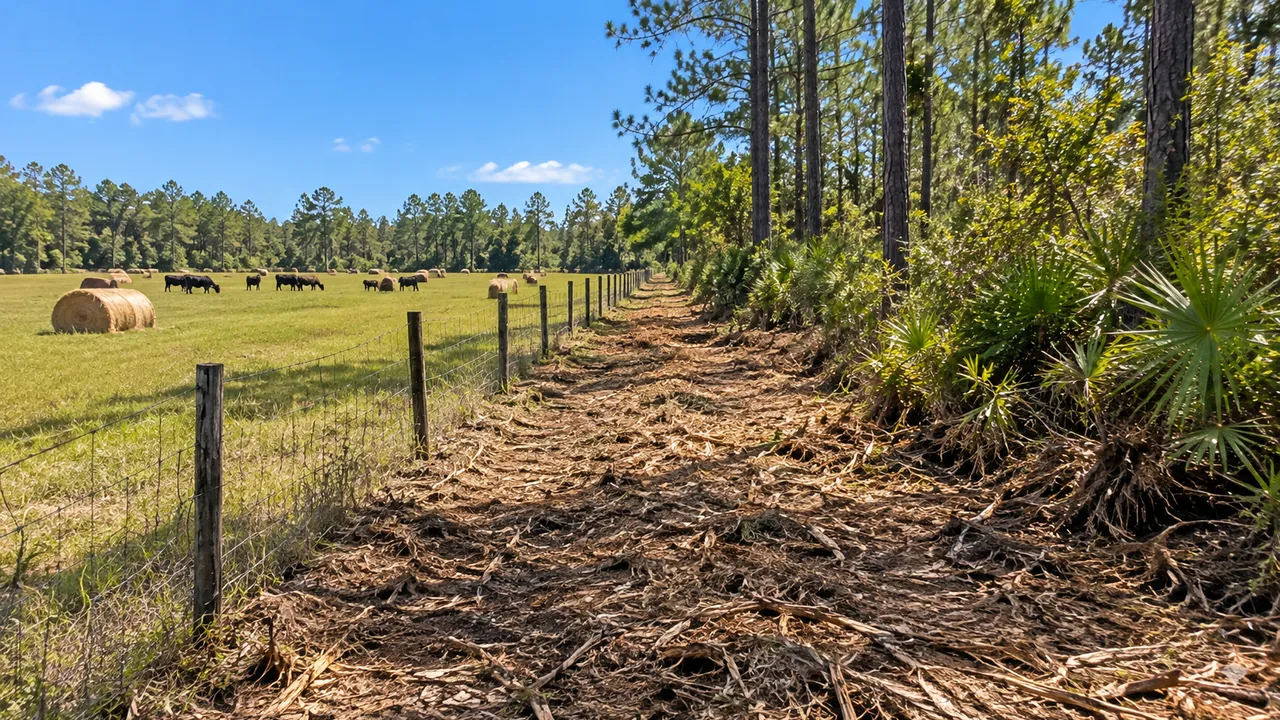
Pasture clearing in western Nassau County usually means one of two jobs: turning pine land into grass, or taking back a pasture that palmetto, wax myrtle and young pines have crept into. Either way it goes further than underbrush clearing, because grass needs the stumps, roots and debris dealt with and a seedbed to grow in. Here's how the work usually goes around Callahan, Hilliard and Bryceville, the rules that apply to farm clearing, what it costs, and where landowners can get help.
Farm land in Nassau County, by the numbers
The USDA's 2022 Census of Agriculture profile for Nassau County counted 346 farms on 47,480 acres, an average of 137 acres each. About three-quarters of that farmland was woodland, with 6,425 acres of pasture. The county had 4,736 cattle and calves and 266 horses and ponies, and hay and haylage was the top crop by acreage. Put simply: far more woods than grass on the county's farms.
Taking back a grown-up pasture
When a field has been let go, palmetto, wax myrtle, gallberry and young pines move in from the fence lines and woods edges. If the growth is still small, a heavy mower may be enough. Once it's woody, forestry mulching grinds it down in one pass and can work close along a fence line. The mulch breaks down over time, but a thick layer may need raking or disking before grass comes back through. Palmetto resprouts, so plan on mowing the edges afterward to hold the line.
Turning pine land into pasture
Some old pine plantation in the county has been converted to pasture, and it's a bigger job than it looks. A typical sequence:
- Sell or harvest the merchantable timber first, if there is any. See clearing after logging.
- Remove or grind the stumps. Hay equipment and mowers need a clean surface. Pulled stumps leave holes to fill; ground stumps leave chips. See stump grinding and removal.
- Level the old planting beds. Slash pine here is planted in long rows on low raised beds, and those ridges have to be knocked down for a mowable field.
- Rake the roots and debris into windrows or piles, then mulch, burn or haul them.
- Disk, lime and fertilize as needed, and plant. Ask the Nassau County Extension office about forages and timing for your ground.
Sand, wet spots and hardpan
Cleared ground here is gray sandy topsoil over light gray to nearly white sand, with a dark hardpan layer in many soils. Parts of the land are poorly drained, with the water table close to the surface for part of the year. Low spots that hold water after rain are worth noticing before you plan a field, and any cypress dome or bayhead on the tract should be checked as a possible wetland before it's cleared. See wet lots and cypress domes.
The rules for clearing farm land
- Gopher tortoises. The FWC says permits aren't required for agricultural activities such as mowing, disking, roller-chopping and tree-cutting. Clearing for development isn't covered. If you're converting woods to pasture and aren't sure which side of that line you're on, ask the FWC's Northeast Region at (352) 620-7732 before the work.
- Water and wetlands. Florida's agricultural exemption (§ 373.406(2), F.S.) lets a person engaged in agriculture alter the topography of their land consistent with normal and customary practice, but not "for the sole or predominant purpose of impeding or diverting the flow of surface waters or adversely impacting wetlands." UF/IFAS notes that the federal exemptions for normal farming and forestry don't cover "mechanized land clearing" of wetlands. The Army Corps of Engineers' Jacksonville District, (904) 232-2568, reviews federal wetland permits in Florida.
- County grading and stormwater. Nassau County's grading permit packet counts forestry as agriculture, says best management practices are still recommended, and ties the state construction permit to nonagricultural disturbance over an acre. Ask Stormwater and Drainage, (904) 530-6390, how your project is treated.
- Inside town limits. Hilliard requires a town permit to remove trees (all pines and several other species are exempt), (904) 845-3555. Callahan's tree permit applies to development that needs a town permit, (904) 879-3801.
- Burning windrows. Agricultural pile burning needs a Florida Forest Service authorization and setbacks of 300 feet from occupied buildings other than yours, 100 feet from a paved public road, and 50 feet from woods and brush. See burning clearing debris.
Where to get help
The Nassau County Extension Service has offices at 543350 US Hwy 1 in Callahan and 85831 Miner Road in Yulee, (904) 530-6353, and its natural resources program covers land management and livestock. The USDA Natural Resources Conservation Service's EQIP program offers "financial and technical assistance" to farmers, ranchers and forest landowners, with applications at the local USDA Service Center (NRCS Florida, September 2024). Ask about signup deadlines and which practices fit your land before any clearing starts.
What pasture clearing costs
Nationally, Angi's September 2026 figures put one acre at $500 to $2,000 if lightly forested and $3,600 to $5,600 if densely forested, with land clearing pros typically charging $110 to $250 an hour. For mulching fence lines and grown-up edges, HomeAdvisor's June 2026 figures run $400 to $1,500 per acre. Converting pine land costs more than either, because stumps, bed leveling, raking and debris all add machine time. These are national figures, not local prices. Plan around the written price a contractor gives after seeing your stumps, beds and fence lines. More on cost.
Pasture questions
Should I sell the timber before I clear?
If the pines are big enough to sell, usually yes, and the sale should be in writing. A forester can tell you what you have. Inside Hilliard, pines are exempt from the town tree permit, but cutting trees in a town right-of-way takes an application and a $1,000 cash deposit, so check with Town Hall first. The Florida Forest Service's County Forester for Nassau, (904) 845-7238, helps landowners with forestry questions.
Grind the stumps or pull them?
For a hay field or anywhere you'll mow, the stumps need to go or be ground well below mower height, and roots raked out. For a rough grazing pasture, some owners leave stumps cut low and let them rot.
Can I leave a few shade trees?
Yes. A live oak or a few pines left standing give cattle and horses shade. Flag them before clearing and keep machines off their roots.
Can the windrows just stay where they are?
They can, but they take ground out of use and give palmetto and vines a place to grow. Mulching or burning them, with the burn authorization, frees up the field.
How we help
Tell us where the field or tract is, the acreage, and whether it's standing pines, cutover or a pasture going back to brush. We forward it to one independent contractor who does farm clearing in western Nassau County. They walk the land and give you a written quote, and you decide. There's no charge for the referral.
Want a local contractor to walk your land?
Call or send a short request. There's no charge for the referral.