
Palmetto and Underbrush Clearing in Callahan, FL
Left alone for a few years, saw palmetto and gallberry can turn open pine woods into a wall you can't walk through. If you own flatwoods around Callahan, Hilliard, Bryceville or western Yulee, clearing that underbrush comes down to four tools: mowing, roller chopping, forestry mulching and prescribed fire. Here's how they compare, why palmetto keeps coming back, what to do about invasive vines and trees, and how to keep a clear break around the house and barn.
What's growing in your woods
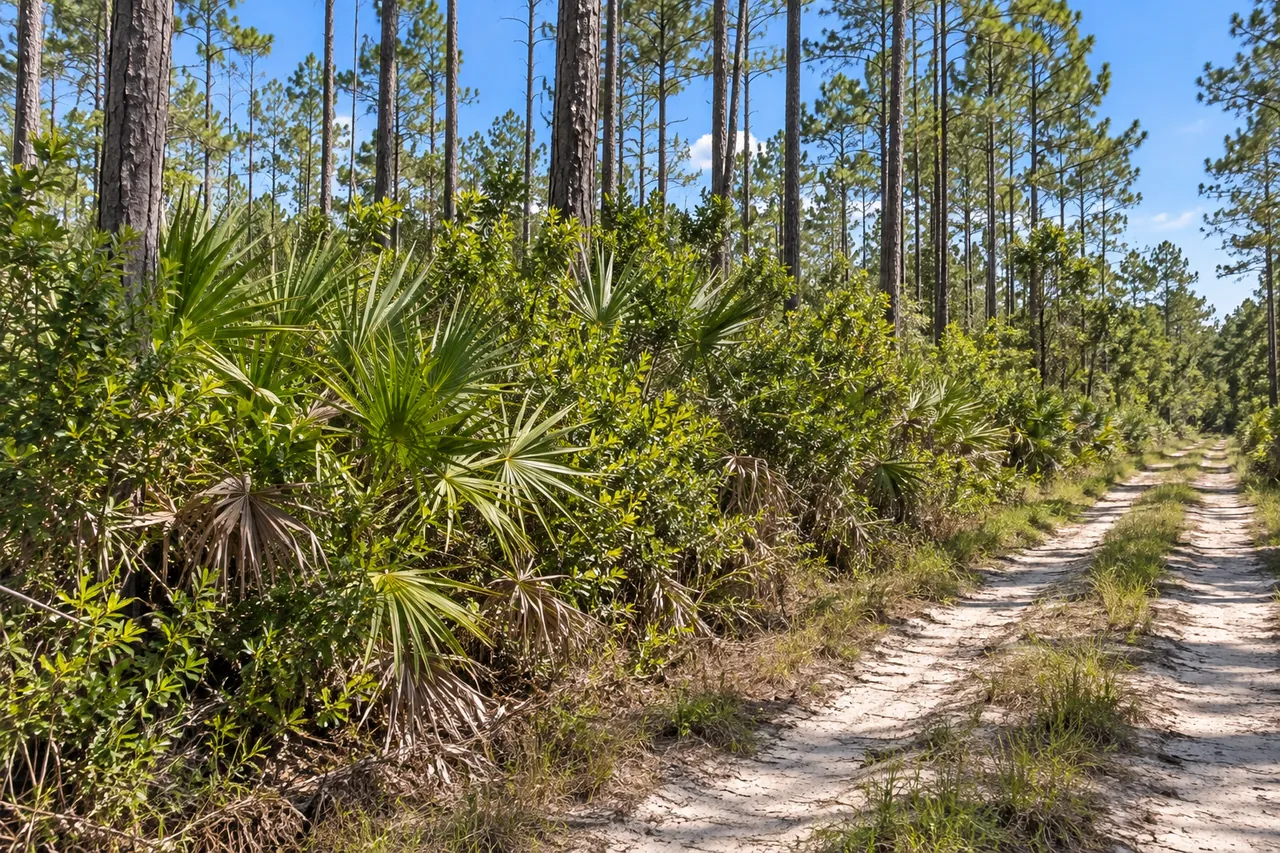
The flatwoods understory here is dense and low and mostly evergreen: saw palmetto (the low, shrubby palm), gallberry, fetterbush, staggerbush, wax myrtle and wiregrass. Over it stand slash pine, loblolly and longleaf, with pond pine in wetter spots and laurel oak, water oak, sweetgum and live oak mixed in.
This is fire country. Palmetto sprouts right back after a fire. Where fire and mowing have been kept out for years, the understory just keeps growing up.
Four ways to knock it back
UF/IFAS Extension's publication FR474 (revised April 2026) compares mechanical alternatives to prescribed fire. It rates roller chopping as the "lowest per-acre price for mechanical treatments," says mowing and mulching costs are "dependent on site and desired mulching coarseness," and notes that mowing and mulching move slower than roller chopping.
- Mowing. A heavy rotary cutter knocks down regrowth and lighter stands fast. It's best for keeping cleared ground open, not for opening up a stand that's gone head-high.
- Roller chopping. A heavy drum with blades, pulled behind a tractor or dozer, crushes and cuts the understory across big acreage. Florida's forestry best management practices say choppers should be pulled perpendicular to streams and other waterbodies so the indentations follow the contour.
- Forestry mulching. Grinds palmetto, gallberry and small trees into chips, can work closely around pines you're keeping, and handles thicker stems than a mower. See forestry mulching.
- Prescribed fire. The traditional way flatwoods are kept open. Florida law limits certified prescribed burning to purposes such as silviculture, wildland fire hazard reduction, wildlife and ecological restoration, and requires a certified prescribed burn manager on site with a copy of the prescription.
Many owners combine them: a mechanical pass to bring an overgrown stand down to something manageable, then mowing or fire to keep it there.
Palmetto comes back, so plan for it
None of these tools ends saw palmetto. It sprouts back after fire, and it comes back after mowing, chopping and mulching too. Think of the first clearing as a reset and budget for upkeep: mowing the sprouts, another pass every few years, or herbicide on the worst patches. If herbicide is part of the plan, ask who will apply it and how. The Nassau County Extension office, (904) 530-6353, runs pesticide certification and land management programs and can point you to current recommendations.
Invasive plants
If invasive plants such as Japanese climbing fern or Chinese tallow are on your land, mulching or mowing knocks them down but doesn't remove them, so plan follow-up treatment and ask the Nassau County Extension office, (904) 530-6353, what currently works. Tell the contractor about them before the job, so the plan covers follow-up rather than only the first pass.
A clear break around the house and barn
Flatwoods are fire country, so a mowed or mulched strip between the woods and your house, barn, fences and equipment gives you a break in the fuel and room to work. Keep it maintained, since the palmetto will try to close it. If you plan to burn the cleared material instead of mulching it, that's a separate set of rules; see burning land clearing debris.
Tortoises and snakes in the underbrush
The FWC lists mowing, roller chopping and prescribed burning among the agricultural and forestry activities that don't need a gopher tortoise permit. Clearing for a house or other development isn't covered, and the FWC's 25-foot rule applies to that work. Either way, flag burrows and keep machines off them. If an eastern indigo snake turns up, the federal protection measures say to stop and let it move away; don't handle it. The FWC's Northeast Region is at (352) 620-7732.
What underbrush clearing costs
National forestry mulching figures give a sense of scale. HomeAdvisor (June 2026) lists $125 to $200 an hour for underbrush and small trees and $200 to $400 an hour for heavy, dense brush, and $400 to $1,500 per acre. Angi (May 2026) lists $1,000 to $2,500 per acre. Those are national figures; overgrown palmetto is dense brush, so don't expect the low end. For mowing and roller chopping, UF/IFAS's comparison above is relative, not a dollar figure. Only someone who has pushed into your palmetto can put a real price on paper. More on cost.
When underbrush clearing isn't enough
- Building a house: the footprint needs stumps and roots dug out. See clearing a house site.
- Making pasture: grass needs the roots, stumps and debris dealt with and a seedbed. See pasture clearing.
- Bayheads and cypress edges: dense bay thickets often mark wet ground, and wetland work can need a state permit. See wet lots and cypress domes.
Palmetto questions
Will mowing kill the palmetto?
No. It knocks it down and it resprouts. Mowing is maintenance, and it works best on ground that's already been opened up.
Can I burn my own woods to clear the palmetto?
Not without the Florida Forest Service. State rule 5I-2.006 says authorization must be obtained for burns relating to agriculture and silviculture. Many owners bring an overgrown stand down mechanically first, or hire a certified prescribed burn manager. Start with the Florida Forest Service's Nassau County Forest Area Supervisor, (904) 845-7121, or the County Forester, (904) 845-7238.
How often will I have to do this?
Plan on some treatment every few years to keep it open. The County Forester, (904) 845-7238, or the Extension office, (904) 530-6353, can suggest a schedule for your stand.
Is there help paying for it?
The USDA Natural Resources Conservation Service's EQIP program offers financial and technical assistance to farmers, ranchers and forest landowners, with applications through the local USDA Service Center. Ask the Nassau County Extension office which service center handles Nassau County, and ask NRCS which practices fit your land.
How we help
Let us know where the woods are, how many acres, and how tall the understory has grown. One independent contractor who takes on palmetto work around Callahan and Hilliard gets your request and can suggest a method on site. They walk the land and give you a written quote, and you decide. There's no charge for the referral.
Want a local contractor to walk your land?
Call or send a short request. There's no charge for the referral.